
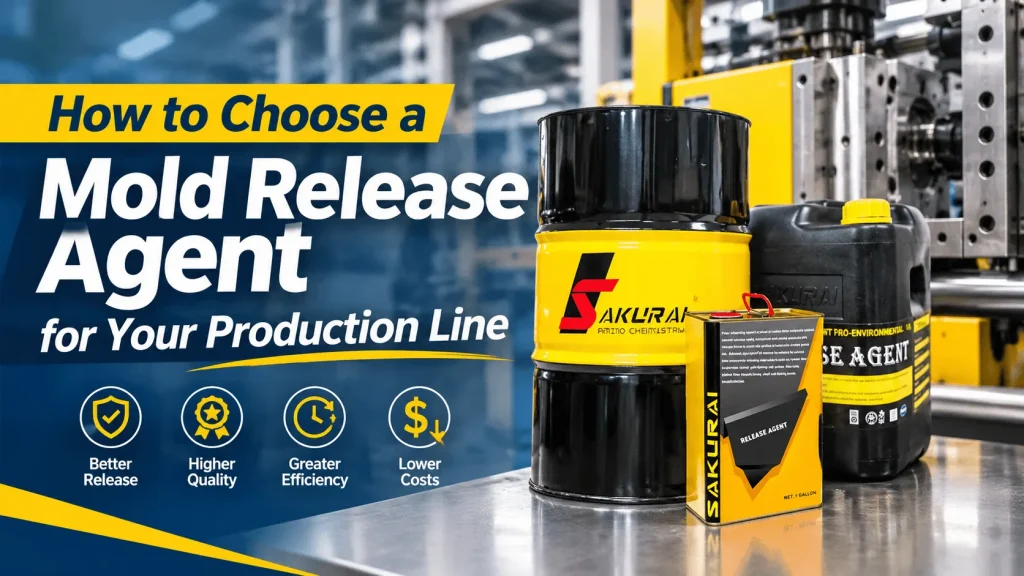
Choosing a mold release agent is a line-selection decision, not a chemistry lesson. At Meiyahg, we specify SAKURAI grades against three variables: substrate and mold material, the temperature window, and cycle time plus post-processing such as painting, bonding, or surface finish. Answer those three questions, shortlist a grade, then trial it on one mold.
Purchasing readers can skip ahead to the plant-trial section for samples, MOQ, and TDS/SDS.

Start with three process questions
Write the answers down before you compare grades. Your process engineer, tooling vendor, and purchasing team will need the same facts later.
- What are you molding, and what is the mold made of? Name the resin or material, and name the tool surface — steel, aluminum, gelcoat, or formwork panel.
- What is the mold or process temperature? Use the tool temperature at release, not the shop-floor reading.
- How fast is the cycle, and will the part be painted or bonded? State the target cycle and the finishing step after demolding.
Substrate and tool material set the chemistry family. A carbon fiber lay-up, an FRP laminate, an epoxy part, an aluminum die-casting shot, and a precast concrete form do not take the same release film. A polished steel tool can also accept a different film from a soft aluminum tool or a coated formwork panel.
Temperature then trims the shortlist: ambient and mid-temperature curing on one side, hot molds and die casting on the other. Cycle time and post-processing decide whether you need a semi-permanent film, a clean surface for paint or bonding, or a silicone-free grade.
Choose by substrate
Start with the material you mold and the tool that holds it, then match a SAKURAI grade. For a view across resin systems, see our composites release agents. For a short definition of the main types, see What Is A Mold Release Agent.
The table below is a shortlist, not a final answer. Your tool temperature and cycle data still decide the grade.
| Substrate | Process | Recommended type | Product |
|---|---|---|---|
| Carbon fiber (plates, sheets, wrap, panels, tubes, shafts, frames, and sporting goods) | Hand lay-up, mold pressing, winding, vacuum pouring, pultrusion | Solvent-based | MK-600-3 |
| FRP / glass fiber (unsaturated polyester, vinyl ester, epoxy, and acrylic; bathtubs, artificial stone, and similar parts) | Hand lay-up, mold pressing, vacuum pouring | Solvent-based, semi-permanent | MK-SC-01 |
| Epoxy (bicycle frames, phone shells, rackets, and other epoxy castings) | Hand lay-up, mold pressing, winding, vacuum pouring, pultrusion | Water-based, no oily residue | MK-W2038 |
| Aluminum die casting (household appliances, motorcycle and medium auto fittings) | Aluminum die casting; automatic or manual spray | Water-based, silicone-free | MK-TC |
| Concrete formwork, precast, and rental forms | Forming and precast casting | Water-based vs oil-based | Concrete release agents |
A few rows need a short note. MK-600-3 is a solvent-based carbon fiber grade; concentrate and ready-to-use versions are both available. MK-SC-01 is a solvent-based, semi-permanent grade for FRP lines that want more releases between coats and less cleaning downtime. MK-W2038 is a water-based epoxy grade specified for no oily residues and no negative effect on post-processing. MK-TC is a water-based, silicone-free grade for aluminum die casting.
Concrete formwork is a separate case. Water-based and oil-based products serve different priorities: release quality, form cleaning cost, and site odor. The concrete release agent page explains the trade-offs. Confirm the correct concrete grade with our team before you order.
Choose by temperature
Temperature splits the shortlist into two working groups. Read the temperature from the tool at release, not from the shop floor.
Ambient and mid-temperature curing
Hand lay-up, many room-temperature epoxy processes, and other open-mold work sit in this window. The film has to build evenly and last through the cure. That does not mean every ambient process should use a water-based grade. Solvent-based grades such as MK-600-3 and MK-SC-01 are commonly used on these lines. Choose water-based MK-W2038 when the epoxy part will be painted or bonded, or when the shop needs a lower-odor, lower-VOC film.
Tool surface still matters. Check compatibility against steel, aluminum, or a coated mold before you lock the grade.
Hot molds and die casting
Heated tools and die casting are hard on a weak film. The layer must survive the tool temperature at demolding and must not break down into residue that dirties the cavity.
For aluminum die casting that will be coated or assembled, specify a silicone-free grade. Silicone can migrate to the casting surface and spoil adhesion. MK-TC is Meiyahg’s water-based, silicone-free SAKURAI grade for this process. The product page states that it is workable within 300°C. No other grade in this selection guide has a published temperature figure, so we will not quote one here.
The TDS is the final authority on temperature, dilution, and coverage. Send your mold temperature with the inquiry so we can check the grade against your process data.
Choose by cycle time and post-processing
Cycle time rewards a film that stays on the tool. A semi-permanent system, such as MK-SC-01 on FRP lines, is meant to last through many releases before you apply again, which cuts cleaning downtime. A conventional film is often quicker to apply, but you reapply more often. Judge a grade by cost per release, not cost per drum: count the demolds you get from one coat, plus cleaning and reapplication labor.
Post-processing decides the film chemistry. Painted or bonded parts need a clean surface after demolding. MK-W2038 is specified for no oily residues and no effect on post-processing. Aluminum die casting follows the same logic with a stricter rule: use a silicone-free grade such as MK-TC when the casting will be painted or bonded.
Water-based versus solvent-based usually comes down to three points:
- Dry speed: on a cool tool, solvent-based grades typically dry faster.
- Odor and VOCs: water-based grades suit enclosed shops and tighter site rules.
- Fire safety: solvent grades need proper storage and ventilation.
The full trade-off is on our water-based vs solvent-based comparison. For most lines, the answer follows post-processing and shop rules, not the drum price.
How to run a plant trial
A datasheet does not prove the grade on your tool. Request a free sample and the TDS/SDS through our contact page, read the TDS before you open the sample, then run the trial in four steps:
- Keep part of the sample sealed for a second run.
- Adjust the dilution ratio to your spray equipment and line speed, not only the lab default. Record the ratio you used.
- Trial on one mold first, and keep the rest of the line on your current agent.
- Log every cycle from the first coat onward.
Do not use up the whole sample at once. A second run lets you confirm a result or test a different dilution without waiting for a new shipment.
Record four acceptance items: clean release with no sticking or tearing; residue and build-up on the tool; post-processing results such as painting or bonding; and how many releases you get per coat. Compare these records against your current agent on the same tool.
When the trial passes, confirm volume. After a successful sample trial, the published MOQ is typically 200 liters for the composite grades above and 200 kg for MK-TC. If you need a custom formulation, include that in the same inquiry.
Start with the substrate table, then send your resin or substrate, mold material, mold temperature at release, cycle time, post-processing, and current agent type to contact us. Ask for a free sample and the TDS/SDS, and trial one grade on a single tool.
FAQ
Can one mold release agent work for every mold and resin?
No. The material you mold, the mold material, and the tool temperature each call for a different chemistry family. A carbon fiber lay-up, an epoxy part, and an aluminum die-casting shot do not take the same film. Start with the substrate table, then confirm the grade against the TDS.
When should a factory choose water-based vs solvent-based?
Choose water-based when parts will be painted or bonded, or when shop odor and VOC rules are strict. Choose solvent-based when you need faster dry on a cool tool, or when the process already points to a solvent grade such as MK-600-3 or MK-SC-01. Post-processing and site fire rules usually make the call.
Why does aluminum die casting need a silicone-free grade?
Silicone can migrate to the casting surface and spoil coating adhesion and assembly. Specify a silicone-free grade such as MK-TC for castings that will be painted or bonded. MK-TC has a published claim of workable within 300°C.
How do we switch from our current supplier without stopping the line?
Trial on one mold first and keep the rest of the line on your current agent. Save part of the free sample for a second run. Log clean release, residue, post-processing, and releases per coat before you commit.
What information should we send to get a recommended grade?
Send your substrate or resin, mold material, mold temperature at release, cycle time, post-processing (painting or bonding), and your current agent type. Meiyahg engineers match a SAKURAI grade to that data and can ship a free sample with the TDS and SDS. Reach us through the contact page.